Home › Sitework and Structural Concrete
Keep your commercial project on schedule with complete sitework and structural concrete services in Raleigh, NC. We build footings, walls, piers, and equipment pads to engineered specs, coordinating closely with other trades on site.
Superior Concrete Raleigh provides professional structural concrete throughout Raleigh, NC, North Carolina and the surrounding area. Our licensed, insured crew delivers safe, clean, on-time work with a free estimate before anything begins. Call (984) 342-0629 or request your free quote.
Sitework and Structural Concrete Done Right in Raleigh
Superior Concrete Raleigh handles sitework and structural concrete as one connected process, not two separate jobs. That matters, because how the site is prepared controls how long your foundations, slabs, and structural elements will last.
On a typical project in Raleigh or surrounding Wake County, we start with a site walk and elevation checks. We look at drainage patterns, soil type, access for concrete trucks, and any tight areas that may need pumping instead of chute placement. We compare what we see on site with your plans, the geotechnical report if there is one, and the City of Raleigh or county requirements for setbacks and stormwater.
We focus on structural concrete for real loads: house and addition foundations, garage slabs, thickened-edge slabs, structural slabs for shops or small warehouses, retaining walls that hold back actual soil pressure, equipment pads, and column or pier foundations. If it has to carry weight or resist movement, it needs structural planning and execution. Our role is to translate the engineer’s details into a build that passes inspection and stays serviceable for decades, not just until the inspection sticker is signed.
Our Sitework Process: Grading, Soils, and Subgrade Preparation
Most structural concrete failures in Raleigh trace back to soil and water, not the mix itself. The sitework phase is where we control those risks.
We begin with stripping organics and unsuitable material. That means removing topsoil, roots, construction debris, and any soft or pumping pockets. If the soil feels spongy under a loaded skid steer or fails a probe test, we undercut it and replace it with compactable fill.
Next is rough grading. Using laser levels or GPS equipment, we cut or fill to get the building pad within the tolerances set on your plans. We shape slopes so surface water runs away from the structure. In Raleigh’s clay-heavy soils, poor grading leads to ponding, which then softens subgrade and causes slab cracking and settlement.
Where the engineer calls for it, we place compacted structural fill. This is typically ABC stone or a specified granular material, brought in, placed in lifts, and compacted with plate compactors or rollers to achieve the density noted in the geotechnical report. For garages, shops, and driveways that will see vehicle traffic, we always recommend at least a compacted stone base even when the minimum code does not demand it.
We then fine grade the subgrade, verify elevations for slab thickness and footing depth, and proof-roll if the inspector or engineer requests it. Any soft areas that show up at this stage are corrected before formwork begins, not ignored and buried under concrete.
How We Build Structural Concrete Foundations and Slabs
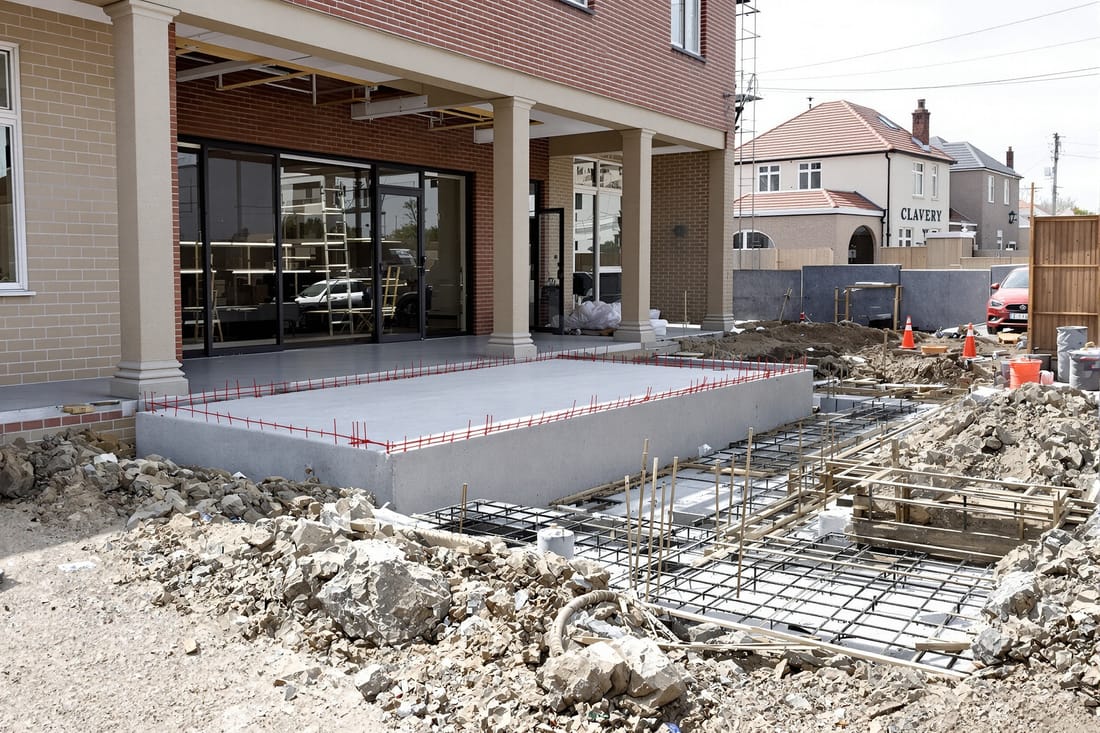
Once the subgrade is correct, we set forms and steel for the structural concrete. For Raleigh-area homes and light commercial projects, this usually means footings, foundation walls, and slabs on grade.
Footings: We excavate to the engineer-specified depth, which commonly runs 12 to 24 inches below finished grade in our region, deeper where frost or expansive soils are a concern. We set forms or use clean, straight trench sides, install rebar cages with proper clearances, and use chairs or bricks to keep steel off the soil. Before any pour, we schedule the footing inspection with the City of Raleigh or the respective county, which checks depth, width, and rebar size and spacing.
Foundation walls and piers: For stem walls or full-height walls, we install panels or block-outs according to plan. Rebar is tied to extend from the footing into the wall, creating one structural unit. We pay close attention to anchor bolt layout, plumbing and electrical sleeves, and any brick ledges or step-downs that need to match framing and masonry later.
Slabs on grade: We set edge forms, interior thickened beams if required, and a vapor barrier where specified. Rebar or wire mesh is placed on chairs so it actually sits in the concrete, not under it. For structural slabs that will support heavy loads, we follow the engineer’s exact bar spacing, bar size, and slab thickness. Concrete mix is typically 3,000 to 4,000 psi with air entrainment as required. We use internal vibrators around thickened sections and rebar congestion to remove air pockets and ensure full consolidation.
Control joints are laid out based on slab thickness and the use of the space. For example, a 4 inch residential garage slab may get saw cuts at panels of roughly 10 feet by 10 feet, while a thicker commercial slab might use doweled construction joints. Proper joint layout controls where cracks occur so they are straight, narrow, and functional instead of random and ugly.
Retaining Walls, Structural Details, and Water Management
Structural concrete in Raleigh is often used in combination with slopes and drainage features. Retaining walls and structural site elements demand particular care because our clay soil holds water and exerts pressure.
For retaining walls, we start with accurate layout for alignment and step heights. Footings are dug below frost depth and to the width and thickness shown on the engineer’s drawings. Rebar cages are assembled and tied on site, with vertical bars doweled into the footing or continuous from bottom to top in a poured wall.
Drainage is the non-negotiable part. We install perforated pipe at the heel or toe, depending on design, surrounded by clean stone and wrapped in fabric if required. The backfill behind the wall is placed in lifts and compacted, with a free-draining zone of stone to relieve hydrostatic pressure. We include weep holes or other relief measures as shown in the plans. Skipping these steps is why many landscape-style walls in the Triangle lean or crack after a few wet seasons.
For structural stairs, ramps, and elevated slabs, we coordinate forming, handrail embeds, and slip-resistance finishes early. On commercial work within Raleigh city limits, inspectors often check ADA slopes and landings, so we confirm elevations and gradients with instruments before pouring. Incorrect slopes mean grinding or replacement later, which is far more expensive than doing it right the first time.
Water management continues at the surface. We pitch slabs away from structures, integrate concrete flumes or swales where needed, and plan discharge points that do not flood neighboring properties. Some HOAs in Raleigh and nearby towns require drainage plans or restrict where you can send runoff. Superior Concrete Raleigh can coordinate with your engineer or surveyor so your sitework and structural concrete support those requirements instead of creating conflicts.
Permits, Inspections, and What Affects Your Cost
In Raleigh and the surrounding municipalities, structural concrete is not a casual trade. Permits, inspections, and engineered details are common, especially for new construction, additions, retaining walls over 4 feet, and commercial work.
We help you navigate who does what. Typically, your general contractor or homeowner pulls the building permit. Superior Concrete Raleigh then schedules specific inspections related to our work, such as footing, foundation wall, slab, and sometimes reinforcing steel or special inspections for larger projects. The City of Raleigh, Wake County, and nearby jurisdictions have published inspection checklists, and we build our internal checks around those so there are no surprises.
Several real factors control cost for sitework and structural concrete:
Soil conditions: Soft spots, organic layers, high water tables, or undocumented fill often require undercutting and replacement with structural fill. Until we see the site or a geotechnical report, those costs are estimates.
Access: Tight lots inside Raleigh, rear-yard projects, or sites with limited truck access may need concrete pumping, smaller loads, or more handwork, which increases labor and equipment time.
Thickness and reinforcing: Structural concrete is priced by thickness, psi rating, and reinforcement. A basic patio slab and a structural shop floor are very different even if they cover the same square footage. The more steel and higher strength mix, the higher the material cost.
Weather and protection: Our region sees freeze-thaw cycles and hot summers. Protecting fresh concrete from freezing or rapid moisture loss sometimes requires curing blankets, curing compounds, or adjusted pour times. When a pour must happen in marginal weather, we factor in those safeguards.
We provide itemized scopes so you can see exactly where your money goes: site prep, base stone, formwork, steel, concrete, finishing, curing, and sawcutting or joint work.
Planning Your Project With Superior Concrete Raleigh
If you are planning new construction, an addition, a detached garage, a structural slab, or engineered retaining walls in the Raleigh area, getting the sitework and structural concrete right is the foundation for every trade that follows.
We usually begin with a conversation about your plans and schedule, then a site visit. For homeowners, we can review your architectural and engineering drawings and identify any details that will impact access, excavation, or concrete placement. For builders and developers, we coordinate with your superintendent and other trades so plumbing, electrical, and HVAC penetrations are in place before slabs are poured.
Expect straight talk on scope and limitations. If you are trying to reuse an existing slab that is too thin or poorly reinforced for new loads, we will explain the risks and alternatives, such as adding a structural topping with proper bond preparation and dowels, or replacing sections outright. If your budget is tight, we can sometimes adjust non-critical finishes while keeping the structural elements fully compliant with the engineer and code.
Throughout the project, you get clear scheduling updates based on inspections, concrete plant availability, and weather. We coordinate with local ready-mix suppliers that understand our specifications, including required psi, slump, and additives. After the pour, we return for sawcutting at the correct time, strip forms, and handle any patching or minor touch-ups that are part of a proper structural concrete job.
Superior Concrete Raleigh focuses on building structural concrete that holds its shape, carries its load, and drains right. If that is what you need for your Raleigh, North Carolina property, we are ready to walk the site and lay out a practical, no-nonsense plan.